Wednesday, September 12, 2012

The Holy Bishop-Martyr Autonomous. (September 12)

Otdanije (leave-taking) of the Feast of the Birth of the Mother of God.

The Holy Bishop-Martyr Autonomous.
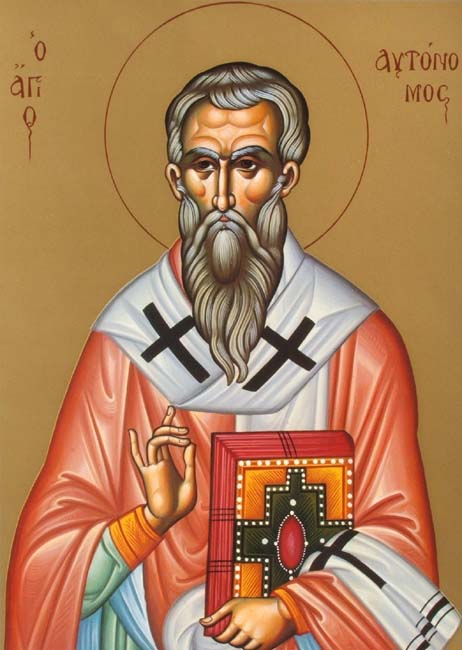

During Diocletian's persecution, Autonomus left Italy for Asian Bithynia, for a place called Soreoi. There, he converted many to Christianity, and built a church for them dedicated to the holy Archangel Michael. Autonomus lived in the home of a devout Christian, Cornelius, whom he first ordained as a presbyter, and then consecrated to the episcopacy. Not far from Soreoi there was a place called Limnae, inhabited entirely by pagans. St. Autonomus went to this place and soon enlightened many with the Gospel of Christ. This embittered the pagans, and one day they rushed into the Church of the Holy Archangel Michael in Soreoi during the divine service and slew Autonomus in the sanctuary, and killed many other Christians in the church. During the reign of the Emperor Constantine, Severian, a royal nobleman, built a church over the tomb of St. Autonomus. Two hundred years after his death, St. Autonomus appeared to a soldier named John. John exhumed the relics of the saint and found them to be completely incorrupt, and many who were sick received healing from Autonomus's relics. Thus, God glorifies the one who glorified Him while living in the flesh.


Respectfully Taken From the:
"The Prologue of Ohrid"
by St. Nikolai of Zica, Serbia(Velimirovic)

Tuesday, September 11, 2012

Our Venerable Mother Theodora of Alexandria. (September 11)

Our Venerable Mother Theodora of Alexandria. 


Theodora was from Alexandria and the wife of a young man. Persuaded by a fortune-teller, she committed adultery with another man and immediately felt the bitter pangs of conscience. She cut her hair, dressed in men's clothing and entered the Monastery of Octodecatos, under the male name of Theodore. Her labor, fasting, vigilance, humbleness and tearful repentance amazed the entire brotherhood. When a promiscuous young woman slandered her, saying that Theodore had made her pregnant, Theodora did not want to justify herself, but considered this slander as a punishment from God for her earlier sin. Banished from the monastery, she spent seven years living in the forest and wilderness and, in addition, caring for the child of that promiscuous girl. She overcame all diabolical temptations: she refused to worship Satan, refused to accept food from the hands of a soldier, and refused to heed the pleas of her husband to return to him-for all of this was only a diabolical illusion, and as soon as Theodora made the sign of the Cross everything vanished as smoke. After seven years, the abbot received her back into the monastery, where she lived for two more years, and reposed in the Lord. Only then did the monks learn that she was a woman; an angel appeared to the abbot and explained everything to him. Her husband came to the burial, and then remained in the cell of his former wife until his repose. St. Theodora possessed much grace from God: she tamed wild beasts, healed infirmities, and brought forth water from a dry well. Thus, God glorified a true penitent, who with heroic patience repented nine years for just one sin. She reposed in the year 490.

Today we also remember St. Autonomous, because of the leave-taking tomorrow. 


Respectfully Taken From the:
"The Prologue of Ohrid"
by St. Nikolai of Zica, Serbia(Velimirovic)


Monday, September 10, 2012

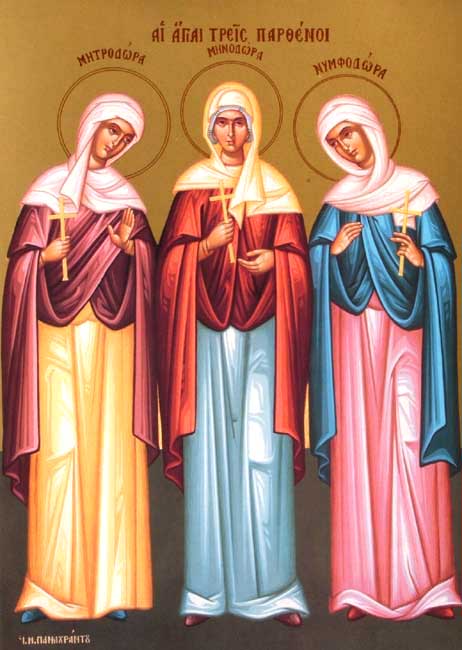
The Holy Martyrs Menodora, Mitrodora and Nymphodora. (September 10)

The Holy Martyrs Menodora, Mitrodora and Nymphodora.


They were sisters by birth and grew up somewhere in Asian Bithynia. Reared in the spirit of Christianity, they withdrew from the city to the wilderness, wishing to elevate their minds to God and to free themselves of everything in this deceitful world, and to live this life in purity and virginity as true brides of Christ. They dedicated themselves to great labor, fasting and prayer, until God adorned them with the gift of miracle-working. When people began to bring the sick to them for healing, they became well known against their will. A certain governor, Fronton, heard of them and brought them to trial. Upon seeing them, the governor was amazed at the beauty of their faces. For, even though they were great fasters and their bodies were withered, their faces were radiant, illumined by inward peace and the grace of God. At first, the governor flattered them and promised to send them to the emperor, who would give them in marriage to his noblemen. But when he was convinced that all of his flattery and promises had no effect on these brides of Christ, he ordered that Menodora be tortured first, and her sisters thrown into prison. After cruel tortures, the governor cried out to Menodora, who was wounded and bloody: ``Offer sacrifice to the gods!'' To this the holy martyr replied: ``Do you not see that I am offering my entire self as a sacrifice to my God?'' When St. Menodora was slain by the tortures, the governor then brought out the remaining two sisters, and stood them by the dead body of Menodora. Pointing to the body of their sister, he counseled them to deny Christ. Since they remained steadfast, he slew them by harsh tortures. Just then, a thunderbolt struck from heaven, and killed the soulless Fronton and his servants. Christians honorably buried the bodies of these holy martyrs of God. They suffered between the years of 305 and 311, during the reign of Maximian Galerius, and found rest in the Kingdom of Christ.


Respectfully Taken From the:
"The Prologue of Ohrid"
by St. Nikolai of Zica, Serbia(Velimirovic)


Saturday, September 8, 2012

FEAST OF THE BIRTH OF THE MOTHER OF GOD. (September 8)

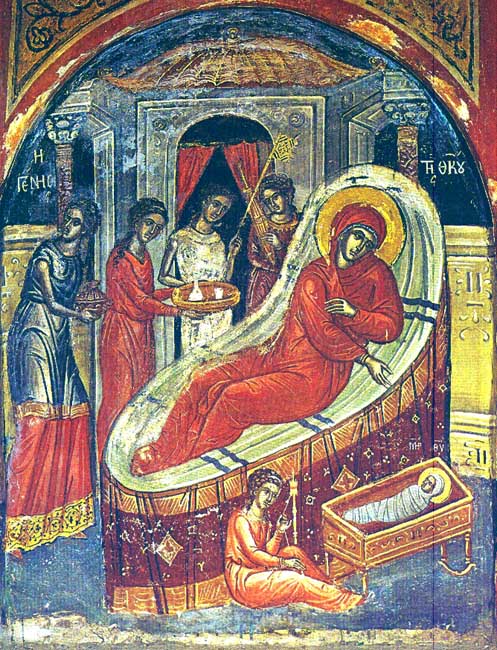
FEAST OF THE BIRTH OF THE MOTHER OF GOD.


 The Holy Virgin Mary was born of aged parents, Joachim and Anna. Her father was of the lineage of David, and her mother of the lineage of Aaron. Thus, she was of royal birth by her father, and of priestly birth by her mother. In this, she foreshadowed Him Who would be born of her as King and High Priest. Her parents were quite old and had no children. Because of this they were ashamed before men and humble before God. In their humility they prayed to God with tears, to bring them joy in their old age by giving them a child, as He had once given joy to the aged Abraham and his wife Sarah by giving them Isaac. The Almighty and All-seeing God rewarded them with a joy that surpassed all their expectations and all their most beautiful dreams. For He gave them not just a daughter, but the Mother of God. He illumined them not only with temporal joy, but with eternal joy as well. God gave them just one daughter, and she would later give them just one grandson-but what a daughter and what a Grandson! Mary, Full of grace, Blessed among women, the Temple of the Holy Spirit, the Altar of the Living God, the Table of the Heavenly Bread, the Ark of God's Holiness, the Tree of the Sweetest Fruit, the Glory of the race of man, the Praise of womanhood, the Fount of virginity and purity-this was the daughter given by God to Joachim and Anna. She was born in Nazareth, and at the age of three, was taken to the Temple in Jerusalem. In her young womanhood she returned again to Nazareth, and shortly thereafter heard the Annunciation of the Holy Archangel Gabriel concerning the birth of the Son of God, the Savior of the world, from her most-pure virgin body.


Respectfully Taken From the:
"The Prologue of Ohrid"
by St. Nikolai of Zica, Serbia(Velimirovic)
Friday, September 7, 2012

Prefestive Day of the Feast of the Birth of the Mother of God. The Holy Martyr Sozon. (September 7)

Prefestive Day of the Feast of the Birth of the Mother of God.


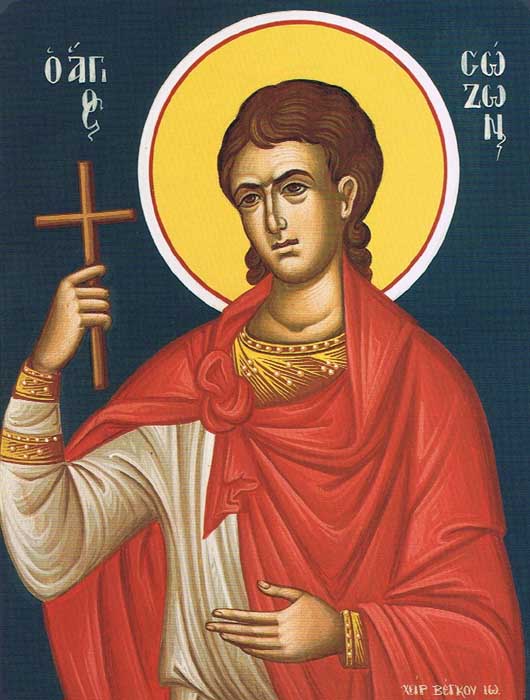
The Holy Martyr Sozon.

 Sozon was born in Lyconia. He was a shepherd and kept all of God's laws, instructing his peers and friends in his pious Faith. In a vision he was shown that he would suffer martyrdom for Christ. This was in the time of Maximian, magistrate of Cilicia, who perpetrated a terrible persecution of Christians in the nearby city of Pompeiopolis. In that city there was a certain golden idol which the pagans worshiped. Sozon left his flock, went to the city, entered the pagan temple and broke the arm off the golden idol. He crumbled it into bits and distributed it to the poor. There was a great uproar because of this, and the pagans sought out the guilty one. So that no one else would suffer for his deed, Sozon went to the magistrate and declared himself to be a Christian and the perpetrator of that act. His torturers first beat him, then suspended him from a tree and scraped his body with iron combs. When he was nearly dead, they cast him into a fire, where St. Sozon gave up his holy soul to God. He suffered in about the year 304. St. Sozon's relics were miracle-working, and a church in his name was built over them.


Respectfully Taken From the:
"The Prologue of Ohrid"
by St. Nikolai of Zica, Serbia(Velimirovic)
Thursday, September 6, 2012

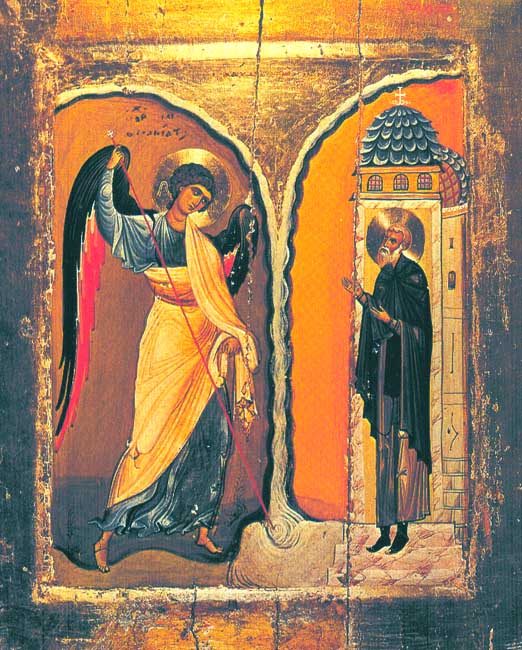
Memory of the Miracle of the Holy Archangel Michael at Colossae in Chionia. The Holy Martyr Eudoxius and His Companions. (September 6)

Memory of the Miracle of the Holy Archangel Michael at Colossae in Chionia. 


Near Hierapolis, in Phrygia, there was a place called Chonae (``plunging''), and in that place there was a spring of miraculous water. When Apostle John the Theologian, accompanied by Philip, preached the Gospel in Hierapolis, he looked upon that place and prophesied that a spring of miraculous water would open up there, from which many would receive healing, and that the great Archangel of God Michael would visit that place. Soon afterward, this prophecy was fulfilled: a spring of water burst forth and became widely known for its miraculous power. A pagan in Laodicea had a daughter who was mute, which caused him great sorrow. Archangel Michael appeared to him in a dream, and told him to take his daughter to the spring, where she would be cured. The father immediately obeyed, brought his daughter to the spring, and found many people there seeking deliverance from various infirmities. These people were all Christians. The man asked how he should seek healing, and the Christians told him: ``You must pray to the Archangel Michael, in the name of the Father and of the Son and of the Holy Spirit.'' The man prayed in this way, gave his daughter a drink of this water, and the girl began to speak. The pagan, his daughter and his whole household were baptized. He also built a church over the spring dedicated to the Archangel Michael. Later, a young man named Archippus settled there and lived a life of austerity, in fasting and prayer. The pagans did many malicious things to Archippus, for they did not like the fact that this Christian holy place emanated such spiritual power and attracted so many people to it. The pagans, in their wickedness, rerouted the nearest river in order to flood the church and the spring. By the prayers of Archippus, the holy Archangel Michael opened a fissure in the rock beside the church, and the river's water plunged into it. This is how that place was saved and why it was called Chonae, or ``of the plunging,'' for the river's water that plunged into the open fissure. St. Archippus labored in asceticism there until the age of seventy, and peacefully reposed in the Lord.

The Holy Martyr Eudoxius and His Companions.


Eudoxius was a commander in the Roman army. He suffered for Christ during the reign of Diocletian. He was tried and tortured by the governor of Melitene in Armenia. His friends Zeno and Macarius also suffered with him, as well as 1104 other soldiers who had been converted to Christianity by Eudoxius. After his death Eudoxius appeared to his wife Basilissa, who remained faithful to Christ to the time of her peaceful repose.


Respectfully Taken From the:
"The Prologue of Ohrid"
by St. Nikolai of Zica, Serbia(Velimirovic)

Wednesday, September 5, 2012

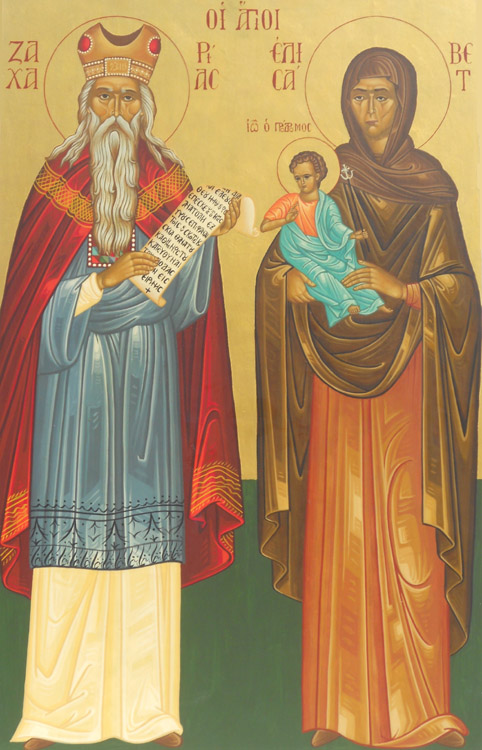
The Holy Prophet Zachary, Father of the Forerunner and His Wife, the Holy and Venerable Elizabeth. (September 5)

The Holy Prophet Zachary, Father of the Forerunner and His Wife, the Holy and Venerable Elizabeth.


He was the father of St. John the Forerunner. Zacharias was the son of Barachias, from the lineage of Abia, of the sons of Aaron. Zacharias was a high priest who held the eighth degree of service in the Temple at Jerusalem. His wife Elizabeth was the daughter of Sophia and sister of St. Anna, who was the mother of the Holy Theotokos. During the reign of King Herod the child-slayer, Zacharias was serving one day at the Temple of Jerusalem according to his turn. An angel of God appeared to him in the sanctuary, and Zacharias had great fear. The angel said to him: Fear not, Zacharias (Luke 1:13), and announced that Elizabeth would bear a son, in answer to their prayers. But both Zacharias and Elizabeth were old. When Zacharias doubted the words of the heavenly herald, the angel said: I am Gabriel, that stand in the presence of God (Luke 1:19). Zacharias was struck dumb from that hour, and could not speak until his son was born and he had written on a tablet: His name is John (Luke 1:63). Then his speech returned, and he magnified God. Some time later, when the Lord Jesus had been born and Herod began to slaughter the children of Bethlehem, he sent men to find and kill the son of Zacharias-for Herod had heard all that had happened to Zacharias, and how John had been born. Upon seeing the soldiers coming, Elizabeth took John into her arms-he was a year and a half old at that time-fled from the house with him, and ran to a rocky and desolate place. When she saw the soldiers following her, she cried out to the mountain: ``O mountain of God, receive a mother with her child!'' and the rock opened and hid the mother and child. Then Herod, enraged that the child John had not been slain, ordered that Zacharias be slain before the altar. The blood of Zacharias was spilled on the marble and dried solid as stone, and remained as a witness to Herod's evil deed. In the place where Elizabeth hid with John a cave opened, water flowed out of it, and a fruit-bearing palm grew, all by the power of God. Forty days after the death of Zacharias, the blessed Elizabeth died. The child John remained in the wilderness, fed by an angel and protected by God's providence, until the day he appeared at the Jordan.


Respectfully Taken From the:
"The Prologue of Ohrid"
by St. Nikolai of Zica, Serbia(Velimirovic)